Music Distribution with Human Support: What to Look For
Most distribution support is a ticket queue. What human support should mean for labels: named senior people and real answers on release day.
If you are searching for music distribution with human customer support, apply one test: can the platform name the person who will answer you before you sign? Most distribution support is a ticket queue with an SLA attached, because at DIY scale that is the only economics that work. For labels, distributors and catalog owners, that model breaks exactly when it matters: on release day, mid-migration, or when a royalty statement does not add up.
Why human support disappeared from distribution
The artist-facing platforms did the math. Serving millions of accounts at a few dollars each means support has to cost close to zero per user: chatbots, help-center deflection, ticket queues, tiered escalation. That is not a moral failure; it is the business model. The result is that “support” in distribution has come to mean response times, not resolution, and the industry adjusted its expectations downward.
But a label running a roster, or a distributor running sub-labels, is not a consumer account. When a flagship release is stuck on one store, when a catalog migration is mid-flight, when an artist is asking why their numbers moved, the question is operational and the cost of a slow or wrong answer is commercial. A ticket queue is structurally incapable of owning that kind of problem.
What human support should actually mean
When you evaluate platforms, look past the word “support” and check for these five things:
- Named people. You should know who works on your account, by name, before you sign. Anonymous queues mean nobody owns your problem.
- Senior people. The person answering should be able to resolve a DSP delivery issue or read a royalty statement, not paste a help-center article.
- Human-led onboarding and migration. Moving a catalog is the riskiest moment in any platform relationship. It should be run by people who have done it before, with your historical streams preserved, not by a wizard and a progress bar.
- Availability when it counts. Release day, not just business hours in one timezone.
- Escalation that reaches the top. In a founder-owned company, hard problems can reach the founders. In a platform owned by a major or a fund, escalation reaches a process.
How limbo/ builds it: Humans as the core module
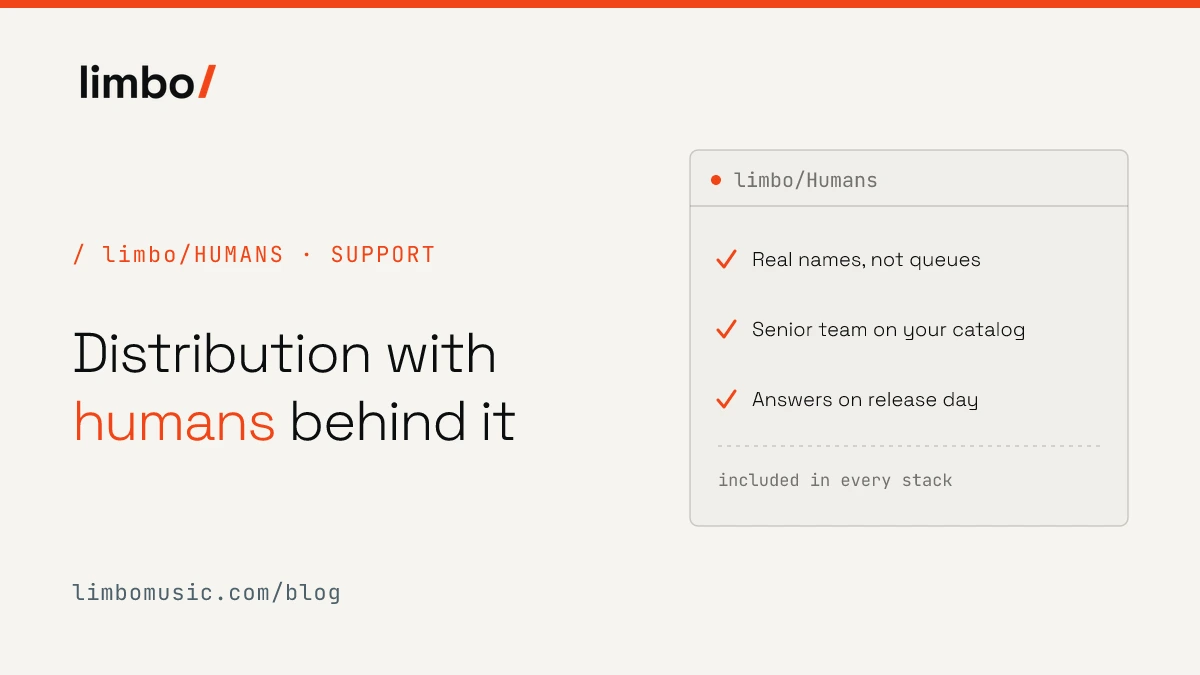
At limbo/, human support is not a tier. limbo/Humans is the foundational Music Block: mandatory, always on, included in every stack, because we think the people behind the platform matter more than any feature on it. Real senior people, with names, who know your catalog and answer when something breaks on release day. The founders still read the support inbox.
The team works across Buenos Aires, Madrid, Barcelona, Valencia, Mexico City and New York, which in practice means coverage across European and American time zones by people employed to know your business, not to close tickets.
Humans and automation are not opposites
The reason human support scales at limbo/ is that machines do the mechanical work first. Agent Quality Control validates every release before it ships: metadata, artwork, audio, fraud and policy checks, which is why delivery takes hours, not weeks. Automation handles the checks; humans handle the judgment. A platform that offers only one of the two is either slow or shallow.
For distributors and labels comparing platforms
If you are an independent distributor or label evaluating infrastructure, human support is one of five checks, not the only one. The others: who holds the DSP contracts, which DDEX versions the platform speaks per store, who can see your royalty data, and how deep the white-label really goes. Two resources for that comparison work: our white-label platforms comparison and the map of who owns your music distributor, because who owns the platform ultimately decides whose interests its support serves.
When you want to run the test from the first paragraph on us, start the conversation. Meeting the actual team is the first meeting.