What Does It Mean to Sell Your Music Catalog (and Why Artists Do It)
What selling a music catalog means: masters vs publishing, full vs partial sales, why artists sell, what happens after, and how to get a valuation.
If you write or record music, your catalog is probably your most valuable asset and the one you understand least as a financial instrument. Lately it is also the one everyone wants to buy. Springsteen, Dylan, Queen, Justin Bieber: the headline deals made “selling your catalog” sound like something only legends do for nine figures. It is not. Deals happen from four and five figures up, and the question underneath the headlines is one any rights holder can ask: what does selling a catalog actually mean, and would it make sense for me?
This guide answers that plainly. No hype, no guarantees. If you want a number for your own catalog, you can get a free, confidential valuation at any point.
What a music catalog actually is
A “catalog” is the bundle of rights and income attached to your body of work. It splits into two distinct copyrights, and the difference matters because you can sell one without the other.
Master recordings (the masters). The recording itself: the specific performance captured in the studio. Whoever owns the master earns when that recording is streamed, sold, or licensed into a film or ad. Labels usually own masters; independent artists who funded their own recordings often own theirs outright.
Publishing (the composition). The underlying song: the melody, lyrics and structure, independent of any one recording. Publishing income flows from streaming, radio and public performance, mechanical royalties, and sync licensing. It is split between the writer’s share (always the songwriter’s) and the publisher’s share.
So a single song can have several owners earning from it at once. When buyers talk about value, they talk in terms of net share: net publisher’s share (NPS) on the publishing side, or net label share (NLS) on the masters side, meaning the cash an owner actually keeps after collection and admin costs. That net figure is what gets valued.
One distinction decides whether you can sell at all: ownership versus a license. Outright ownership of a master in perpetuity is a sellable, financeable asset. A time-limited license that reverts to the artist later is structurally hard to sell. If you own, you have something to sell. If you only license, you mostly do not.
What “selling your catalog” actually means
Selling does not have to mean handing over everything forever. It is a spectrum, and the structure is the whole negotiation.
- Full sale (100%). You assign the entire interest, income and copyright, permanently. Cleanest and largest cheque, total loss of future upside on what you sold.
- Partial or fractional sale. You sell a percentage of the income and keep the rest, often keeping the copyright and control. Capital now, upside retained.
- One copyright, not both. Sell your masters and keep your publishing, or the reverse. Many artists sell recordings and hold onto the writer’s share.
- Co-ownership / minority stake. Increasingly the market norm: the buyer takes a stake and becomes a partner rather than the sole owner. This is where negotiated protections live.
What transfers is the economic interest you agreed to sell, and usually the copyright in that interest. What you keep is everything you did not sell, plus, in most jurisdictions, your authorship: selling does not erase that you wrote or recorded the work. We go deeper on structures, and on what each one means for tax and control, on the sell-your-catalog page.
Why artists sell their music catalogs
The reasons are financial, practical and personal, and they tend to stack.
A certain sum now instead of an uncertain stream. Royalties are not a stable annuity. Most songs earn the most in their first couple of years, then decay toward a long, flat tail. Selling converts decades of uncertain, declining income into a large, known amount today. For an older catalog past its decay curve, a strong multiple now often beats waiting to collect a shrinking stream.
Risk transfer. When you sell, the buyer inherits the downside: streaming-rate changes, platform dependency, currency swings, Spotify’s threshold that a track must clear 1,000 streams in 12 months before it earns anything, and the dilution from large-scale streaming fraud (industry estimates put roughly 10% of streams as fraudulent, skimming a pro-rata pool where a stream pays only about $0.003 to $0.005). All of that becomes someone else’s problem.
The tax angle (US). This is the single clearest financial incentive in the United States. By default, royalties on self-created works are taxed as ordinary income, up to 37% federal. But under IRC §1221(b)(3), a songwriter can elect to treat a sale of those works as a capital asset, taxed at long-term capital-gains rates, around 20% federal. That is an IRS-recognized structural advantage, not a loophole. Treatment differs by country and by situation, so this is general information, not advice.
Reinvestment and runway. Proceeds fund the next record, a tour, a business, a house, or paying off debt, without giving up equity or signing to a label. As Ryan Tedder of OneRepublic put it when he sold a majority stake (reported around $200M in 2021), the point was to fund real estate and ventures: sell your past to fund your future.
Estate planning. For heritage artists and estates this is often the strongest reason of all. A lump sum, or structured proceeds, is far easier for heirs to divide than an illiquid, hard-to-value, admin-heavy royalty stream. It can also avoid probate disasters: Prince died without a will, and his estate spent roughly six years in probate with tens of millions in fees. Travis Tritt framed his own sale simply: he would rather leave his family cash than “a huge headache” to administer.
Diversification. For most rights holders the catalog is a dangerously undiversified single asset. Selling some of it lets you rebalance into something less concentrated, or simply into certainty.
What happens after you sell
Here is the honest counter-case, because a good decision needs both sides.
In a full sale, the buyer now owns the interest and controls its licensing. They can approve a sync you might have turned down, and US law gives music no moral-rights protection, so the only creative guardrails are the ones you negotiate before signing. If a song you sold goes viral or lands a huge sync afterward, that windfall is the buyer’s, not yours. And the emotional weight is real: Rod Stewart walked away from a deal because his catalog “represents my life’s work.” That instinct is legitimate.
Two things soften the finality. First, structure: a partial sale or co-ownership lets you keep a share of the upside and a contractual voice, including written use restrictions (no political-campaign use, no specific brand categories) and sometimes buy-back options. Second, the law: for self-authored compositions, the US Copyright Act generally lets an author or their heirs terminate a grant and reclaim the copyright in a five-year window beginning 35 years after the transfer, overriding “in perpetuity” language. It does not apply to works made for hire, and its reach over sound recordings is legally contested, but for songwriters it is a genuine safety net.
What about the promise that a buyer will “grow” your catalog? Be skeptical of guarantees. The evidence cuts both ways. On one side, active stewardship has clearly grown some catalogs: Primary Wave said it “basically quadrupled the earnings stream” of the Whitney Houston estate, and after the Bob Marley: One Love biopic, Luminate reported global on-demand streams up roughly 150% in the first full chart week. On the other side, a due-diligence review of the Hipgnosis fund found that passively held catalogs grew better than actively managed ones, and that 75% of its catalogs missed growth forecasts. The honest synthesis: a partner can add value through specific, ownable levers (recovering uncollected royalties, registering neighboring rights, opening sync doors), but no one can promise your streams or fandom will grow. Anyone who guarantees that is selling you something.
Real examples (reported)
These figures are press-reported, not audited, but they show the range and the logic.
- Bruce Springsteen to Sony (2021): a catalog deal reported around $500M to $550M.
- Bob Dylan: publishing to Universal (2020, reported $300M to $400M) and recordings to Sony (2022, reported north of $150M).
- Queen to Sony (2024): reported around $1.27B, said to be the largest single-artist deal.
- Michael Jackson estate, roughly half to Sony (2024, reported around $600M).
- Justin Bieber to Hipgnosis Songs Capital (2023, reported around $200M).
- Katy Perry to Litmus (reported around $225M).
- Britney Spears to Primary Wave (reported around $200M, announced early 2026).
Notice the pattern: many of these are heritage or deep catalogs, where most of the value sits outside streaming, in radio, public performance, sync and brand. If you only look at your Spotify line, you will undervalue your own work, because a serious buyer is paying for the parts you are not counting.
How to decide, and how to get a number
Start with three questions. Is my catalog growing or fading? A still-climbing catalog argues for keeping some upside (a partial sale), because buyers price on trailing earnings and underprice a rising catalog. A seasoned catalog past its decay curve more often suits a fuller sale. What do I actually need the capital for? Runway, estate certainty, a label’s next signings: the goal shapes the structure. How much control do I want to keep? That decides full versus partial versus co-ownership.
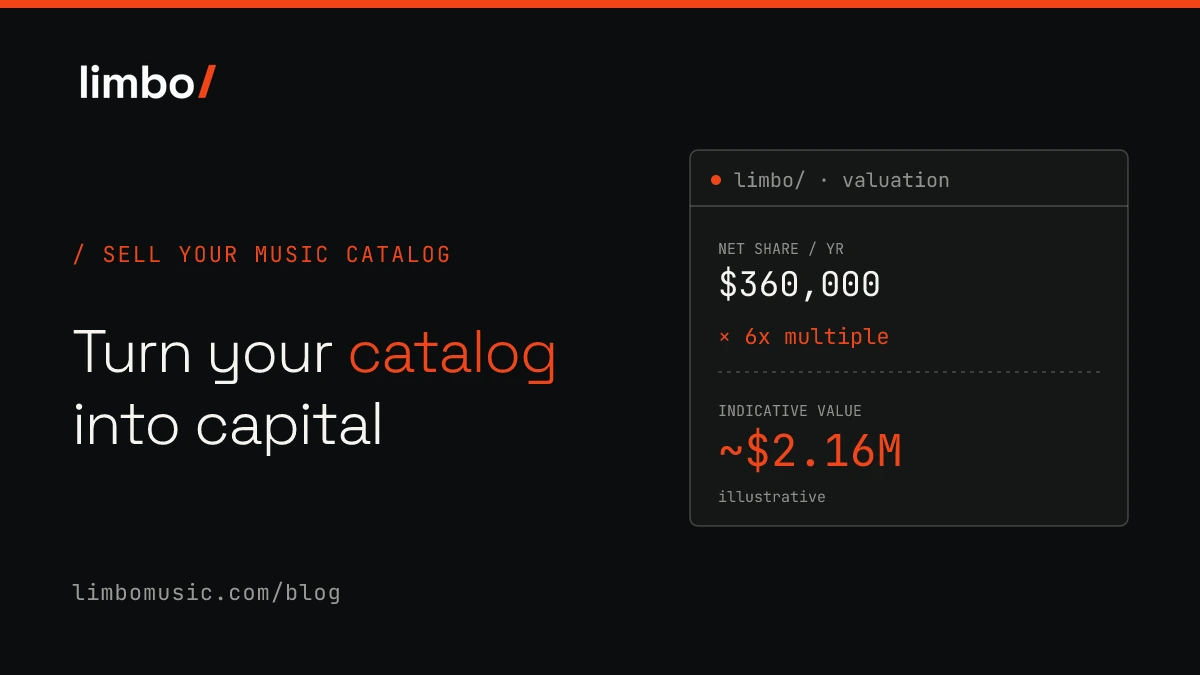
You cannot answer the money side from a blog post. Valuation is a multiple applied to your net share. In practice, catalog sales typically start around 5x net share and reach 10x only in exceptional cases; the 15x to 20x figures you see in the headlines are rare mega-catalogs, not the norm. The multiple moves with vintage, trend, sync potential and the rate environment. The only way to get a real figure is to have someone run your actual numbers.
That is what we do. limbo/ is an independent, founder-owned music-tech company, and we work with professional investor partners to acquire catalogs, from a single track to a full catalog, 100% or partial. We lead with transparency about the trade-off and with the operational work we can actually do (recovering uncollected royalties, registering neighboring rights), not with promises we cannot keep.
Get a free, confidential valuation of your music catalog. No obligation, no rate card, no pressure: just a number and an honest read on whether selling makes sense for you. You can also read more on the sell-your-catalog page.
This is general information, not tax, legal, or financial advice. Treatment is jurisdiction- and fact-specific. Consult a qualified professional.