How to Start a Music Distribution Company in 2026
How to start a music distribution company or become a music aggregator in 2026: DSP access, DDEX delivery, royalties, and build-vs-white-label, step by step.
The short answer
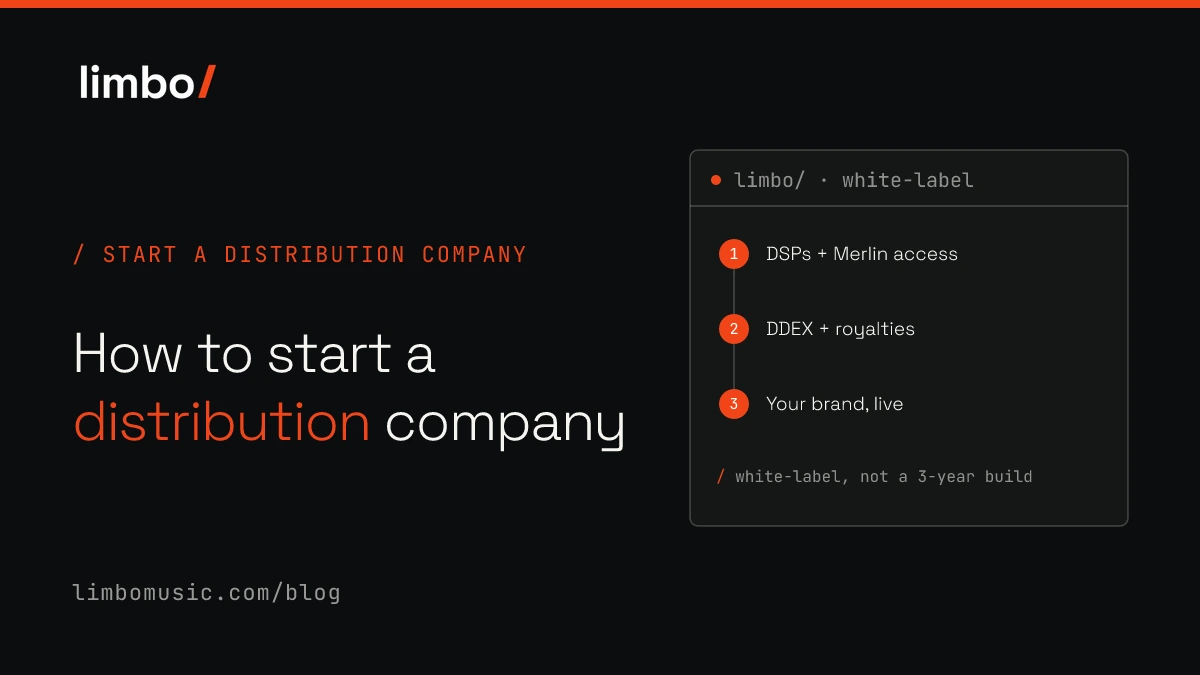
To start a music distribution company in 2026 you need six things: access to the DSPs (direct contracts or Merlin membership), a DDEX delivery pipeline to send releases, a royalty accounting system to pay your clients accurately, metadata validation so deliveries do not fail, fraud protection so your DSP relationships stay clean, and support your clients can reach. You can build all of it yourself, or run it on white-label infrastructure and launch under your own brand in weeks. This guide walks both paths.
Build it or white-label it: the real decision
Everything else follows from this one choice.
Building in-house means writing DDEX delivery, negotiating each DSP relationship, building a royalty engine, and maintaining the per-DSP protocol map as specs change. It is years of engineering and a standing operations cost. It only makes sense at serious scale, and even then most large players license infrastructure rather than rebuild it.
White-label means you run a distribution business under your own name on top of a platform that already holds the DSP relationships, the DDEX delivery, the royalty engine and the fraud tooling. Your brand on the front, proven infrastructure behind it. This is how most new distributors and aggregators launch, because it turns a multi-year build into a go-to-market decision.
If you are starting now, white-label is almost always the honest answer. The rest of this guide assumes it, and flags what to verify.
What you actually need (and what to verify)
1. DSP access. You need a way onto Spotify, Apple Music, YouTube, TikTok, Amazon and the rest. Direct contracts take time and volume; Merlin membership gives independents competitive economics without a major behind them. Verify your platform holds real relationships and delivers to the platforms your clients care about.
2. DDEX delivery. Every release is a DDEX message plus media. Ask which ERN versions your platform speaks (you want 4.3 and 3.8.2, per-DSP) and whether metadata is validated before queueing. Read what DDEX is if this is new.
3. Royalty accounting. You will pay clients from DSP sales reports. The engine has to ingest DSR line by line and handle splits, recoupment and statements. If royalties are estimated rather than reconciled, you inherit the disputes. limbo/ runs royalties on Curve, private by design: the royalty platform co-owned by Merlin and kept independent of every major.
4. Multi-client management. As an aggregator you run many labels and artists under one roof. You need sub-accounts, roles and permissions, and per-client reporting: a multi-tenant white-label platform gives you this out of the box.
5. Fraud protection. Artificial streaming can get your whole channel penalized by DSPs. Ask what the platform does about it. limbo/ runs AI-powered Agent Quality Control and is a Music Fights Fraud Alliance member.
6. Support and independence. Your clients will have release-day emergencies. Named human support matters. And in a market where the majors are buying the infrastructure, check who owns the platform you build your business on: if a major owns your vendor, your client data flows through your competitor.
The launch checklist
- Decide build vs white-label (for almost everyone starting now: white-label).
- Confirm DSP coverage and Merlin access.
- Confirm DDEX ERN 4.3 and 3.8.2, per-DSP, with pre-queue validation.
- Confirm royalty accounting with real DSR ingestion, splits and statements.
- Confirm multi-tenant sub-accounts, roles and per-client reporting.
- Confirm fraud detection and DSP-relationship protection.
- Confirm named human support and independent, uncompromised data ownership.
- Register your business, sort tax and payout rails, and brand your front end.
How limbo/ fits
limbo/ is B2B music distribution infrastructure built as modular Music Blocks. To start a distribution company you would typically combine White Label (your brand, your domain, multi-tenant sub-accounts), Distribution (DDEX-native delivery on direct + Merlin deals to 40+ platforms), Royalties (on Curve, private), and the API with a native MCP server if you want to build your own front end. Independent and founder-owned, so your clients’ data never flows through a major.
Start the conversation
We do not publish a rate card, because the right setup depends on your catalog, your model and how much you want to own. Tell us what you want to build and we will put together a commercial proposal. Talk to limbo/.
Related reading: what white-label music distribution is, the 2026 platform comparison, and who owns your music distributor.