80.5%
of people in Mexico who play, sing or compose do it for fun.
INEGI 2026 [25]
limbo/ Research · October 2026
The state of music making 2026. What verified data from a dozen countries says about the people who make music, what stops them, and what it means for the industry.
Key findings
80.5%
of people in Mexico who play, sing or compose do it for fun.
INEGI 2026 [25]
1 in 2
US adults who never learned an instrument wish they had.
YouGov 2022 [3]
1 in 10
people in Japan play an instrument, steady since 2011. Nowhere is music making booming or collapsing.
Statistics Bureau of Japan [29]
39%
of Americans who learned guitar still play it. 51% of those who quit regret it.
YouGov 2022 [3]
55%
of people in the UK who stopped playing did it between 12 and 18.
ABRSM 2025 [2]
88%
of the 253 million tracks on streaming services had 1,000 streams or fewer in 2025.
Luminate 2025 [15]
The full report
16 charts, 12 countries, every figure checked against its source. Free. Leave your work email and the report opens here, with a PDF to share.
A letter before the data
I grew up in a house where music was not a job. It was the way the world made sense. I have spent twenty years building infrastructure for people who make music. I live between the piano and the code.
This year we kept hearing the same idea: that making music is a chore. That it takes too long, asks for too much practice, and the smart move is to skip the hard part.
So we went to the data. Official surveys, statistical offices, industry censuses, a dozen countries, every figure checked against its source.
People do not want less music. They want to get through the hard part. Hard is not the enemy. Hard is the challenge, and the challenge is where the joy lives. When you truly love something, time disappears.
What makes it hard today is everything around the craft. Time. Money. Lessons families cannot afford. The teenage years. And an attention that social media trained to jump every few seconds, when a song asks for the opposite.
The deal on the table is to hand over the human part in exchange for the least possible effort. We think that is a bad deal. We use technology every day, and we build it. What we refuse is the extractive kind. We are independent, and we intend to stay that way.
This report is not a complaint. It is a map. Soft on people, hard on the problem.
Fer Isella, co-founder and CEO
With love, since 2006.
Chapter 1
Different questions, so do not compare the bars between countries. The direction is the same.
INEGI MODECULT 2026, people 12+ who play, sing or compose [25] · MIZ/Allensbach 2025, amateur musicians 16+, several answers allowed [1] · ABRSM 2025, current music makers [2]
100 US adults. 66 learned an instrument at some point. Of the 34 who never did, 17 wish they had.
YouGov, Musical Instrument Experiences, US adults, n = 3,000, 2022 [3]
Share of people who make music, each country against itself. Every panel uses the same 0 to 30% scale, but definitions and ages differ, so read each panel on its own.
Japan [29] · US NEA [4] · Germany MIZ [1] · Spain Ministry of Culture [5] · Brazil Itaú/Datafolha [26] · Australia [6] · France [9] · UK ABRSM, indicative [2] · Mexico INEGI, share of people doing any art [25]
Japan, share who played an instrument in the past year, by age. One in three at 10 to 14.
Statistics Bureau of Japan, Survey on Time Use and Leisure Activities 2016, population 10+ [29]
Men report playing more in the US, Spain, Brazil and Mexico. In Japan, women do.
US NEA 2022 [22] · Spain 2024/25 [5] · Brazil 2025, music incl. singing [26] · Mexico 2026, share of people doing any art [25] · Japan 2016, 10+ [29]
Chapter 2
US adults who learned each instrument: share who still play it, and share of quitters who regret quitting.
YouGov 2022, US adults who learned each instrument [3]. Retention is reported per instrument, not for any instrument overall.
Germany, share who make music, by age. Each bar is a different group measured at the same time.
MIZ/Allensbach 2025 [1]. UK: 55% of people who stopped an instrument stopped between 12 and 18 (ABRSM 2025, base 350) [2].
UK children who never learned an instrument, reasons given.
ABRSM, Making Music 2025, n = 673 [2]. Adults aged 16+ in Germany cite lack of time first (54%) [1].
Chapter 3
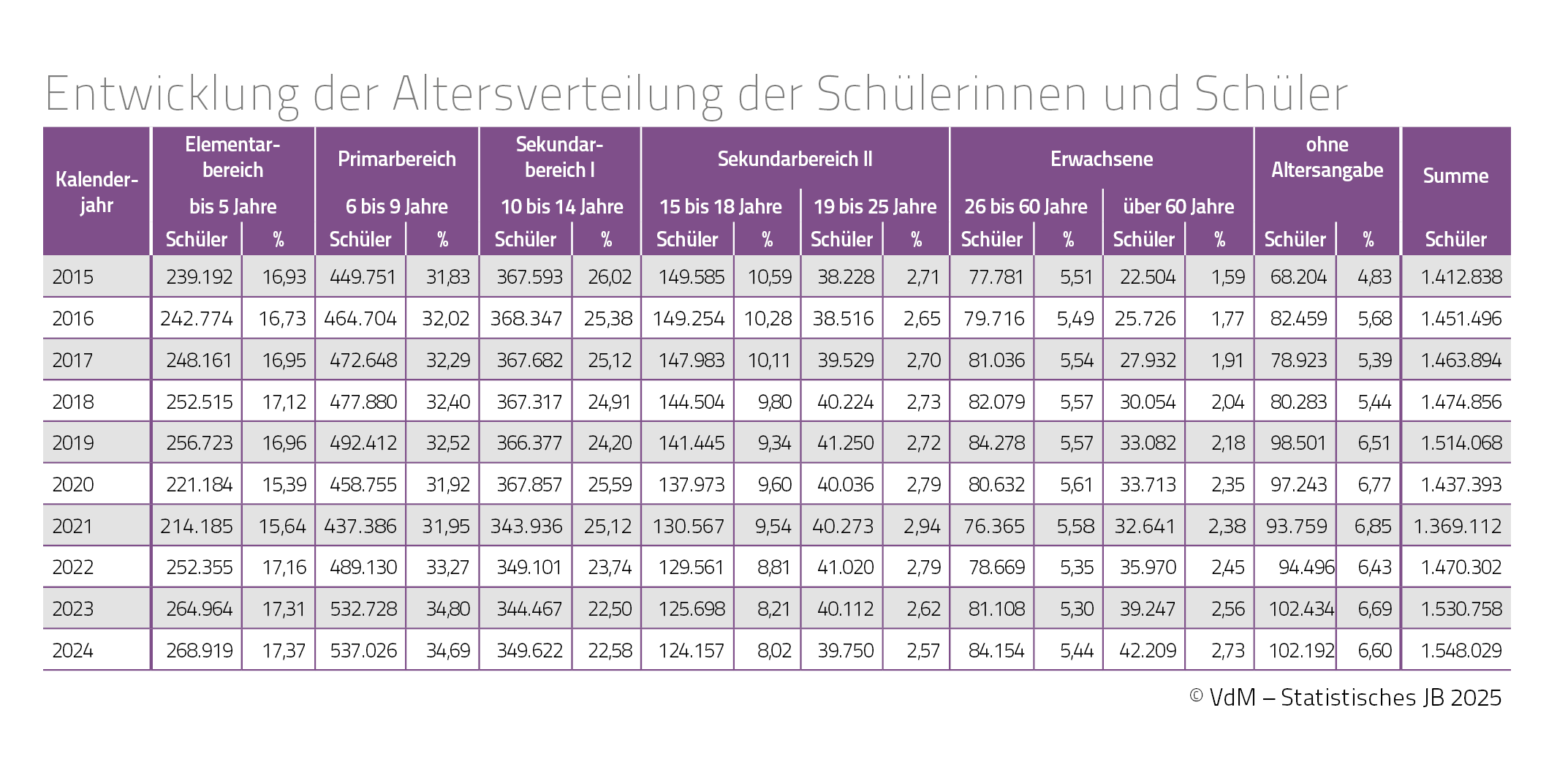
German public music schools, students indexed to 2015 = 100.
VdM, Statistisches Jahrbuch 2024 and 2025 excerpt [10]. Our calculation. Not adjusted for the size of each age group.
Students sitting GCSE Music, UK.
JCQ results tables; 2010, 2019 and 2023 are provisional figures from JCQ booklets [12]
US music products, estimated retail value of shipments, 2021 to 2025.
NAMM 20-Year Global Music Products Summary, 2026 [14]. Changes are our calculation; NAMM's printed change column contains errors.
Acoustic pianos shipped from Japanese factories, units (exports included).
MIC/METI Economic Structure Survey via Shizuoka Prefecture [31]. In the US, digital piano shipments rose 6.4% in 2024 to 188,255 units [14b].
Chapter 4
253M
audio tracks on streaming services in 2025
Luminate [15]
106K
new tracks delivered every day, 7% more than in 2024
Luminate [15]
96.2%
of daily deliveries came through independent or DIY distribution
Luminate [15]
The 253 million tracks on streaming services in 2025, by streams received in the year.
Luminate, 2025 Year-End Music Report [15]. The 1,000+ band is our calculation (253M minus the three lower bands).
The 541,000 tracks with 1 to 50 million streams each, against the whole catalog. The roughly 12,300 biggest hits are not included.
Luminate, 2025 Year-End Music Report [15]. Share of catalog is our calculation.
Chapter 5
Share of new tracks Deezer received each day that were fully AI-generated, by Deezer release date.
Deezer Newsroom, company-reported [16]. The last point is a peak-day figure, not an average.
Fully AI-generated tracks on Deezer: share of daily deliveries on peak days (June 2026) and share of total streams (2026).
Deezer Newsroom, company-reported [16]. In some months of 2025, up to 85% of streams on these tracks were detected as fraudulent.
80%
of adults in eight countries want fully AI-generated music clearly labeled
Deezer/Ipsos 2025, online, 18 to 65 [18]
82.7%
of UK music consumers say human creativity is essential to music
BPI/AudienceNet 2025 [19]
45%
of music creators used no AI music app in the past year
MIDiA 2025 [17]
Chapter 6 · Our reading
This chapter is limbo/'s opinion, built on the data above.
Teens and stalled progress are where people leave. Feedback, teachers, collaborators and a reason to finish a track matter more than an easier first minute.
Cost, school and owning an instrument are solvable. Practice is the craft itself.
A catalog where almost half the tracks get ten streams or fewer is a cost, not a measure of creativity.
When more than half of peak-day deliveries can be fully AI-generated, quality control has to happen before delivery.
Most listeners want fully AI-generated music labeled. Provenance should travel with the track.
Tracks with 1 to 50 million streams carry almost half of all listening. They deserve infrastructure built for them.
Method, limits and sources
We started from about 80 figures circulating in industry research and AI-generated briefs, added new research on the US, Latin America and Asia, and traced every figure to the publisher's own document, or in a few cases to an official relay. Figures that could not be traced were dropped. We compare each country only with itself, because definitions differ. Questions about enjoyment are asked of people who still make music, so people who stopped are not in those answers.
All sources accessed between 28 September and 21 October 2026.
[1] Institut für Demoskopie Allensbach for the German Music Information Centre (MIZ), Amateurmusizieren in Deutschland 2025. https://www.ifd-allensbach.de/fileadmin/IfD/sonstige_pdfs/Amateurmusiz…
[2] ABRSM, Making Music 2025: Extending our Ambition for Music Education in the UK. https://www.abrsm.org/sites/default/files/2025-04/Making%20Music%20202…
[3] YouGov, Musical Instrument Experiences (US, June to July 2022, n = 3,000): toplines and crosstabs, https://d3nkl3psvxxpe9.cloudfront.net/documents/toplines_Musical_Instr… ; article, https://yougov.com/en-us/articles/43512-young-americans-increasingly-e…
[4] National Endowment for the Arts, Arts Participation Patterns in 2022: Highlights from the Survey of Public Participation in the Arts, October 2023. https://www.arts.gov/sites/default/files/2022-SPPA-final.pdf
[5] Ministerio de Cultura de España, Encuesta de Hábitos y Prácticas Culturales en España 2024-2025. https://www.cultura.gob.es/dam/jcr:f6d9b66a-ac72-4d89-8986-7f6c6e94aaa…
[6] Creative Australia, Creative Transformations: Results of the National Arts Participation Survey (2025 survey). https://creative.gov.au/sites/creative-australia/files/documents/2026-…
[7] INE Chile and Ministerio de las Culturas, Encuesta Nacional de Participación Cultural y Comportamiento Lector 2024, Síntesis de resultados. https://www.ine.gob.cl/docs/default-source/participacion-cultural-y-co…
[8] JLeiva Cultura & Esporte and Datafolha, Cultura nas Capitais, national results, March 2026. https://culturanascapitais.com.br/wp-content/uploads/2026/03/Capitais-…
[9] Lombardo, P. and Wolff, L., Cinquante ans de pratiques culturelles en France, DEPS, Ministère de la Culture, July 2020. https://www.culture.gouv.fr/Media/Medias-creation-rapide/CE-2020-2_Cin…
[10] Verband deutscher Musikschulen (VdM), Statistisches Jahrbuch der Musikschulen in Deutschland 2024, https://www.musikschulen.de/medien/doks/zahlen_und_fakten/2024/statist… ; 2024 student and age statistics (from the VdM 2025 yearbook excerpt, read from a published table image), https://www.musikschulen.de/musikschulen/fakten/schuelerzahl-altersver… and https://www.musikschulen.de/medien/doks/zahlen_und_fakten/2025/vdm_sta…
[11] Fender press release, 16 October 2018, https://www.prnewswire.com/news-releases/guitar-isnt-dead-research-sho… ; Fortune, 6 July 2017, https://fortune.com/2017/07/06/guitar-legend-fender-is-getting-into-th… ; Fender Play, https://www.fender.com/play ; Yousician, https://yousician.com/company ; Music Business Worldwide on Yousician's 2021 funding round, https://musicbusinessworldwide.com/yousician-raises-28m-in-b-round-new…
[12] Joint Council for Qualifications (JCQ), GCSE and A level results tables: GCSE 2026, https://www.jcq.org.uk/wp-content/uploads/sites/2/2026/08/Table-1-GCSE… ; A level 2026, https://www.jcq.org.uk/wp-content/uploads/sites/2/2026/08/Table-1-A-le… ; GCSE 2024 and earlier, https://www.jcq.org.uk/wp-content/uploads/sites/2/2026/01/GCSE-Full-Co… ; 2010 figure from the JCQ 2011 results booklet (provisional).
[13] Ministerio de Educación, Formación Profesional y Deportes, EDUCAbase, students in music education 2024-2025. https://estadisticas.educacion.gob.es/EducaJaxiPx/Tabla.htm?path=/no-universitaria/…
[14b] NAMM, 2025 NAMM Global Report. https://www.namm.org/sites/default/files/2025-11/NAMM2025GlobalReportV…
[14] NAMM, Sound Check: A 20-Year Look at the Global Music Products Industry (20-Year Global Music Products Summary), September 2026, downloaded 7 October 2026. https://www.namm.org/sites/default/files/2026-09/NAMM_20_Year_Global_M…
[15] Luminate, 2025 Year-End Music Report, January 2026. https://luminatedata.com/wp-content/uploads/2026/01/2025-Year-End-Musi…
[16] Deezer Newsroom, releases of 24 January 2025, 16 April 2025, 11 September 2025, 12 November 2025, 29 January 2026, 20 April 2026 and 21 July 2026. https://newsroom-deezer.com/2026/07/ai-music-exceeds-50-percent-daily-…
[17] MIDiA Research, Why the music industry needs to learn to live with AI, 29 January 2026, https://www.midiaresearch.com/blog/why-the-music-industry-needs-to-lea… ; The music industry remains divided on generative AI, 27 October 2025, https://www.midiaresearch.com/blog/the-music-industry-remains-divided-… ; survey size, https://www.midiaresearch.com/blog/music-creator-economy-recalibration
[18] Deezer and Ipsos, AI music survey, 12 November 2025. https://newsroom-deezer.com/2025/11/deezer-ipsos-survey-ai-music/
[19] BPI and AudienceNet, 30 April 2025. https://www.bpi.co.uk/news/2625735
[20] PRS for Music, AI survey 2026, 29 January 2026. https://web.archive.org/web/20260203043319/https://www.prsformusic.com…
[21] APRA AMCOS and Goldmedia, AI and Music, August 2024. https://www.apraamcos.com.au/about-us/news-and-events/ai-in-music-repo…
[22] National Endowment for the Arts, By All Means, the Arts: A Full Report of the 2022 Survey of Public Participation in the Arts, August 2025, https://www.arts.gov/sites/default/files/SPPA_Comprehensive_Report_FIN… ; NASERC Indicator B.3, https://arts.gov/sites/default/files/b3-report-202403.pdf
[23] National Assessment Governing Board, 2016 NAEP Arts (8th grade, about 8,800 students across music and visual arts), https://www.nagb.gov/content/dam/nagb/en/documents/newsroom/naep-relea… ; https://www.nationsreportcard.gov/arts_2016/files/infographic_2016_art…
[24] Arts Education Data Project, National Arts Education Status Report 2019, https://artseddata.org/national_report_2019/ ; metrics, https://artseddata.org/metrics2019/
[25] INEGI, Módulo sobre Eventos Culturales Seleccionados (MODECULT) 2026 and 2025, https://www.inegi.org.mx/contenidos/saladeprensa/boletines/2026/modecu… ; https://www.inegi.org.mx/contenidos/programas/modecult/doc/resultados_… ; https://www.inegi.org.mx/contenidos/saladeprensa/boletines/2026/modecu… ; https://www.inegi.org.mx/contenidos/saladeprensa/boletines/2025/modecu…
[26] Observatório Fundação Itaú and Datafolha, Hábitos Culturais 2025 (16 to 65, n = 2,432). https://s3.sa-east-1.amazonaws.com/prd.editor.fundacaoitau.org.br/publ…
[27] SInCA, Encuesta Nacional de Consumos Culturales 2017, https://www4.hcdn.gob.ar/cultura/observatorio/pdfs/CPONSUMOS%20CULTURA…
[28] DANE, Encuesta de Consumo Cultural 2020 and 2017, https://www.dane.gov.co/index.php/estadisticas-por-tema/cultura/consum… ; annex tables, https://www.dane.gov.co/files/investigaciones/eccultulral/anexos_ecc_1… and https://www.dane.gov.co/files/investigaciones/eccultulral/2017/persona…
[29] Statistics Bureau of Japan, Survey on Time Use and Leisure Activities (社会生活基本調査) 2021, 2016 and 2011, https://www.stat.go.jp/data/shakai/2021/pdf/gaiyoua.pdf ; https://www.stat.go.jp/data/shakai/2016/pdf/gaiyou.pdf ; https://www.stat.go.jp/data/shakai/2011/pdf/houdou.pdf ; https://www.stat.go.jp/data/shakai/topics/pdf/topics105.pdf ; 2006 national figure read in a Mie Prefecture release, https://www.pref.mie.lg.jp/DATABOX/26802004044.htm
[30] Yamaha Corporation, investor presentations, 20 February 2023 and 28 November 2025 (CR). https://www.yamaha.com/ja/ir/investor-digest/presentations/pdf/present… ; https://www.yamaha.com/ja/ir/investor-digest/presentations/pdf/present…
[31] Ministry of Internal Affairs and Communications and METI, Economic Structure Survey, piano shipments, via Shizuoka Prefecture. https://www.pref.shizuoka.jp/kensei/information/myshizuoka/1002260/104…
[32] China Musical Instrument Association, January 2024. https://www.cmia.com.cn/hyjd/9577.html
[33] IFPI, Global Music Report 2026, press release, 18 March 2026. https://www.ifpi.org/global-music-report-2026-global-recorded-music-re…