What Is a Royalty Advance? (and Why Artists and Labels Take Them)
What a music royalty advance is, how recoupment works, why artists and labels take them, advance vs catalog sale, and the honest trade-off. You keep your music.
If you make music, sooner or later you need capital: to record, to tour, to market a release, to sign the next artist, or just to stop waiting on royalty statements that arrive months late. One way to get it without selling your music or signing to a major is a royalty advance. Here is what it actually is, how it works, and the honest trade-off, so you can decide whether it fits.
If you want to see how this works at limbo/, we explain it on the royalty advances page. This guide is the plain-English background.
What a royalty advance is
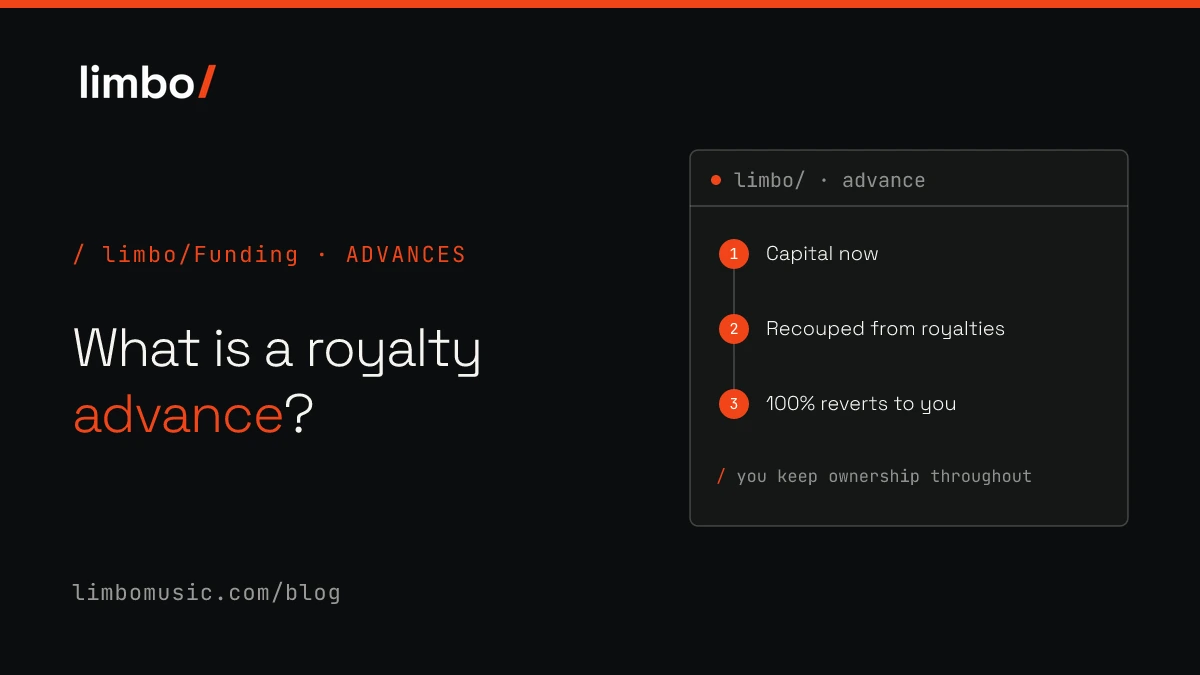
A royalty advance is capital today against your future royalties. You receive a lump sum now, and it is paid back over time from a share of the royalties your music earns. The key point, and the thing that separates it from a record deal or a catalog sale: you keep ownership of your music. An advance is not a sale and not equity. Your masters and your publishing stay yours.
Think of it as bringing forward money you would otherwise collect slowly, over years, so you can use it now while you are still the owner of everything.
How it works: recoupment, in plain terms
The mechanism is called recoupment. Three steps:
- You get a lump sum upfront, sized to what your catalog actually earns.
- A share of your royalties pays it back over time, until the advance plus its agreed cost is recouped. There is no fixed monthly payment and no personal debt. If your royalties come in slower, the recoupment just takes longer.
- It reverts to you. Once the advance is recouped, the funder’s claim ends and 100% of your royalties are yours again. You owned your music the whole time.
Because repayment is tied to your earnings rather than a calendar, an advance is not a loan in the traditional sense. There is no interest clock ticking on a fixed schedule and, in a well-structured deal, no collateral or personal liability.
Why artists and labels take an advance
The reasons stack, and they are mostly about control and timing.
- You keep your music and its upside. If a track takes off after the advance, that growth is yours, not a buyer’s. This is the headline difference from selling a catalog.
- It is not debt in the usual sense. No fixed payment, no missed-payment spiral. Repayment flexes with your royalties.
- Capital to grow, without dilution. Fund recordings, a tour, a marketing rollout, or a label’s next signings, without giving up equity or signing to a major.
- Speed and certainty of cash. Instead of waiting on quarterly statements, you get a known sum now and can plan around it.
- It works across your income. Advances can be built against masters, publishing, or both.
The catch, said plainly: an advance is recouped from your future royalties, so during recoupment you receive less of them, and you repay more than you received. That difference is the cost of getting the money early. A good funder shows you that cost up front; a bad one buries it.
Advance vs loan vs selling your catalog
These three get confused, so here is the difference:
- A bank loan is repaid on a fixed schedule, usually needs credit or collateral, and does not care how your music performs.
- A royalty advance is repaid only from your royalties, with no fixed schedule, and you keep ownership. Repayment flexes with performance.
- A catalog sale is not repaid at all: you receive a larger, certain sum and transfer ownership of the interest you sell. The upside on what you sold becomes the buyer’s.
A simple way to choose: if you want liquidity but want to keep your music and its future upside, an advance usually fits. If you want the largest possible sum and certainty, and you are ready to let go of ownership, a sale fits. We walk through that decision on the limbo/Funding page, and the sale side in what it means to sell your catalog.
The honest part: when an advance is the wrong call
An advance is a good tool, not a free one. It is the wrong call when you take more than your catalog can comfortably recoup, when the cost is hidden or the recoupment share is so high it strangles your cash flow, or when what you actually want is to exit entirely (in which case a sale is cleaner). Be skeptical of anyone who pitches an advance as “free money” or guarantees your earnings will grow. The right number is the one you can see in full and live with.
How to decide, and how to get one
Start with the goal: what is the capital for, and how soon do you need it? Then look at your real royalty data, not a guess. The fairer, faster offers come from a funder who can already see your actual earnings rather than working from a statement you email in.
That is why limbo/ offers royalty advances exclusively to its distribution clients: because we already distribute and account for your catalog, we build the offer on real, current numbers, and you keep 100% of your music. The amount, the recoupment share, the term and the cost are structured per deal, and you see every number before you sign.
See how royalty advances work at limbo/, or compare an advance with a catalog sale.
This is general information, not tax, legal, or financial advice. An advance is recouped from your future royalties. Terms are deal-specific. Consult a qualified professional.