LabelGrid Alternative: limbo/ vs LabelGrid, Compared Honestly (2026)
An honest limbo/ vs LabelGrid comparison for labels, distributors and music apps: what each platform charges for, and why the economics flip as you grow.
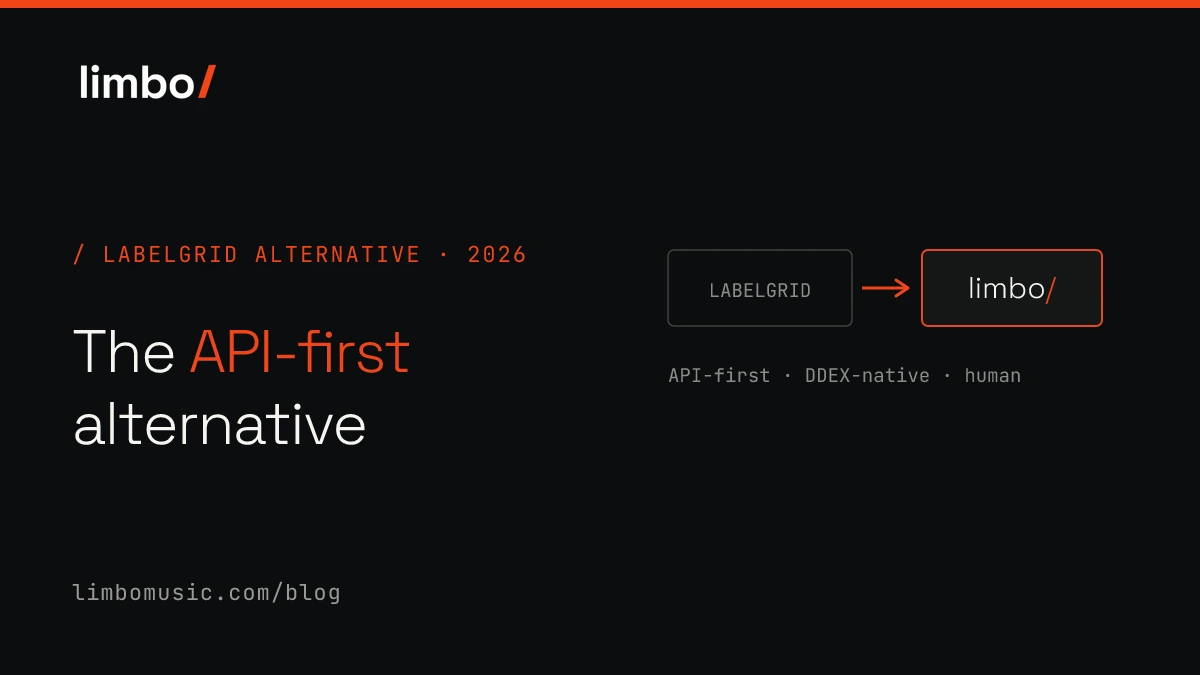
Short answer: LabelGrid is a real option for Merlin members and white-label operators, and the question worth asking is whether your provider is a supply chain or another licensor. If you hold your own Merlin membership or your own direct DSP contracts, what you need is SOBO (supply-own-back-office) delivery: DDEX-native delivery, per-DSP and per-territory controls, independent royalty reporting and quality control, with your agreements staying in your name. That is the model limbo/ runs, and limbo/ has been a Merlin member since 2014.
The short answer
LabelGrid is software you subscribe to with a card. limbo/ is a strategic partner you build with after a conversation. Both deliver to every major DSP, both are Merlin members, both are independently owned, and both are good at what they were built for.
The structural difference is what each platform charges you for. LabelGrid meters your growth on three axes at once: catalog size, the number of label portals you run, and how much you earn each month. Cross any one of them and your plan moves up. It also splits its offer into three separate products: Distribution, Engine (the API) and Imprint (the white-label portal), each with its own pricing logic.
limbo/ meters one axis: catalog size. The white-label platform and the full API are both included in every plan, your roster is unlimited at every level, and there is no ceiling on your monthly royalties, ever.
This comparison is written by one of the two companies, so check the claims. Everything here about LabelGrid comes from their public pages, which they publish openly and in full. That openness is to their credit and it is what makes an honest comparison possible.
limbo/ vs LabelGrid at a glance
| limbo/ | LabelGrid | |
|---|---|---|
| Product structure | One platform. White-label and full API both included | Three products: Distribution, Engine (API), Imprint (white-label) |
| What moves your plan | Catalog size only | Catalog size, label seats and monthly royalties |
| Revenue ceiling | None | Each API plan caps monthly royalties; crossing it moves you up |
| Account structure | Three tiers, unlimited: you, your labels, their artists | One tier of label portals, capped per plan, extra seats in packs |
| Royalty reporting | Runs on Curve, included in your fee | In-house accounting |
| Quality control | Agent Quality Control at no cost on limbo/ deals | Preflight QC and Stream Radar, sold separately, price on request |
| Content ID / UGC rate | Lower, with a dedicated human copyright team | A single flat rate, the same on every plan |
| Advances | Yes, with marketing support behind them | Not offered |
| AI access | MCP server in production since 2025 | MCP server launched July 2026 |
| Custom development | Named team builds features to order | Self-serve product, shared roadmap |
| Support | Named humans, under 24 hours on every plan | Email on entry plans, account manager on the top tier |
| How you get in | Application and a human conversation | Self-serve signup, 7-day trial, card on file |
| Ownership | Independent since 2006 | Independent, Denver, United States |
When does limbo/ cost less than LabelGrid?
Sooner than the entry prices suggest, and the mechanism matters more than any number.
LabelGrid’s bill is set by whichever of its three meters you hit first. Every Engine plan carries a cap on monthly royalties: earn past it and you move up a tier even if your catalog never grew a single track. Add label portals past your plan’s allowance and you buy seat packs. Grow past the published ladder and you land in a custom tier that starts well above it.
limbo/’s bill is driven by catalog size alone. Signing more labels costs nothing. Opening artist accounts under those labels costs nothing. A record quarter costs nothing. If you distribute under limbo/ DSP deals we earn a commission, so we are already aligned with your revenue and have no reason to meter it twice.
The consequence: the faster your revenue and roster grow relative to your catalog, the sooner limbo/ becomes the cheaper platform, at full list price, before any introduction program. LabelGrid is genuinely less expensive for a partner who is small on every axis and intends to stay that way. For a partner whose royalties and roster are climbing, the math flips, and it flips earlier than most evaluators expect. Run the projection with both pricing structures side by side; we will happily do it with you on a call, against your real numbers.
There is one profile that will always pay limbo/ more: a very large catalog that earns very little. We are comfortable being the expensive option there. Catalogs shaped like that are rarely businesses.
For labels and artists: distribution with capital behind it
LabelGrid charges you to distribute. limbo/ does not.
On LabelGrid, a label pays an annual subscription for access and, on LabelGrid’s DSP deals, also leaves a share of royalties behind. Two payments. On limbo/, distribution partners pay no platform fee at all: a commission on royalties, sized to the catalog, and nothing else. If you do not earn, we do not earn. That is the entire model.
Distribution at limbo/ can also come with something no self-serve software company offers: capital. Through strategic partnerships, investor partners of limbo/ fund advances for artists and labels, and then put marketing work behind those same releases so the advance recoups faster. The people financing you are invested, literally, in your music reaching listeners. A subscription platform cannot play this game; it was never designed to.
Every release also passes Agent Quality Control before it ships, at no cost on limbo/ deals, so a launch does not bounce at the DSP or drag a copyright problem behind it.
To be fair to LabelGrid: if you are a solo artist or a small label that wants to upload this afternoon, pay a low annual fee and never speak to anyone, their self-serve plans are exactly that, and they do it well.
For white-label operators: three tiers, no seat tolls
limbo/’s white-label platform is live with real partners. LabelGrid’s is a waiting list. And the limbo/ account tree goes one level deeper than theirs.
LabelGrid’s white-label product, Imprint, is currently in early access with pricing scoped at onboarding. The limbo/ white-label platform is the core of the product and has been running operations for years: your domain, your brand, your partners never see a limbo/ mark.
The structural difference is the account tree. limbo/ runs a three-tier sub-account architecture: you as the operator, your record labels underneath you, and each label’s artists underneath them. Every tier gets its own interface, its own permissions and its own audit trail, approvals route up the tree, and there is no charge and no cap at any level.
LabelGrid’s structure has one tier: label portals, capped per plan, with additional seats sold in packs. There is no artist layer below the label. For a distributor, that means the exact activity your business exists to do, signing labels who sign artists, is either a billing event or simply not modeled.
For API builders: one platform, two doors
On limbo/ the API is not a separate product, so growing into it is a technical decision, not a commercial renegotiation.
Very few teams start with an API. They start with a platform, learn what their operation needs, then build their own product on top of the pipe. On limbo/ that moment costs nothing: the full REST API across every Music Block is already in your plan, alongside the white-label portal. Start on the portal, move to the API in eighteen months, or run both permanently: same account, same catalog, same royalty history, same fee.
On a three-product structure, that same moment means moving from one product to another, with its own ladder, its own caps and its own conversation.
What building on the limbo/ API gets you beyond the endpoints:
- Named developer support on every plan, not only at the top of the ladder. A person who knows your integration, answering in under 24 hours.
- An MCP server in production since 2025, the first in B2B music distribution and covered by Music Business Worldwide at launch. It does not just answer questions about your data: it runs distribution and analytics tasks in plain language, and you can open it to your labels and their artists. Most of the market shipped its first MCP server this year; ours has a year of real catalogs behind it.
- DDEX-native delivery in and out, ERN 4.3 and 3.8.2, on a supply chain the platforms trust.
- Custom endpoints and features, built to order. More on that below, because it is not an API perk, it is how the whole company works.
- A guided integration test before you sign, so we both find out whether your team and our platform fit before money moves.
Where LabelGrid wins here, plainly: they publish full API pricing with no sales call, their docs sit behind no demo wall, and they offer a sandbox environment. limbo/ provides a guided test environment and a demo platform pre-loaded with real data, but not a full sandbox with simulated distribution. If a self-serve evaluation is a hard requirement for you, that is a real point in their favour.
Your software factory, not just your vendor
This is the difference no feature table captures, and no other distributor offers it.
When you buy self-serve software, you get the roadmap. Your feature request joins a queue behind every other account’s, and the product optimises for the average. That is the right way to build self-serve software, and it is why self-serve software is cheap.
limbo/ works like a software factory for its partners. If your operation needs a report that does not exist, a delivery flow that matches how your label actually works, or an integration nobody else uses, that becomes work we do, with a named team. And when what you asked for makes the whole network better, we build it once and every partner gets it. Several features in the platform today started as one partner’s problem. Collective intelligence, compounding on your roadmap: each partner who joins makes the platform stronger for all the others.
For a label or distributor without in-house engineering, this is functionally a development team whose salaries you are not paying.
Royalties on Curve, and why that suddenly matters
In August 2026, Merlin and Jamen Capital completed the acquisition of Curve Royalty Systems, the royalty processing platform used by thousands of labels, distributors and publishers. Curve had ended up inside Universal Music Group through UMG’s purchase of Downtown, and regulators required UMG to divest it, precisely so that a major label could not see the royalty data of the independent companies competing with it. Curve now operates as a standalone business, co-owned by the organisation that represents the independent sector, the same organisation limbo/ has belonged to since 2014.
limbo/ runs its royalty reporting on Curve, and our partners do not pay Curve’s fee: it is included in the limbo/ fee. Your statements, balances and payouts run on the platform regulators just moved out of a major’s hands, with no line item on your invoice. LabelGrid runs its own in-house royalty accounting, which works, but ask yourself which reporting stack you want an auditor, an investor or an artist’s manager to see behind your numbers.
The same logic runs through everything we choose: limbo/ is not owned by a major, and now neither is the platform your royalties are calculated on. In a market where FUGA belongs to Universal and Revelator to Warner, that sentence is getting harder to say, and we intend to keep saying it.
Content ID is human work, so we staff it with humans
Content ID and UGC monetisation on YouTube, Meta and TikTok is where rights get messiest: overlapping claims, disputes, assets registered by three parties at once, revenue that quietly stops arriving because a claim was released two months ago and nobody noticed.
LabelGrid handles this at a single flat rate that is the same on every plan, the one number in their pricing that never moves no matter how large you get. The limbo/ rate is lower than theirs, and behind it sits a dedicated copyright team that watches every Content ID asset in your catalog and handles registration, manual claiming, disputes and overlaps for you. Your contract lists exactly which reporting lines fall into which category, so there is never an argument about what was counted as what.
The door, and the mission behind it
Anyone can open a LabelGrid account with a card and start delivering during a 7-day trial. No vetting, no conversation. That is a real convenience, and it also means the catalog sitting next to yours in that supply chain was never looked at by anyone.
limbo/ holds meetings with every prospective partner before access. Not to gatekeep for its own sake, but because we do not sign clients, we sign strategic partners, and a partnership only works when the vision is aligned long term. Delivery relationships are collective assets: fraud rings move between platforms, reuse the same accounts and catalogs, and the damage lands on everyone sharing the pipe. Our door policy, our KYC on every account tier, and Agent Quality Control exist to protect the partners who did nothing wrong.
All of it serves one mission, and we state it plainly: to grow the global GDP of independent human music. Every advance we structure, every claim our copyright team wins back, every feature the software factory ships, is that mission with a task number on it. If that reads as too idealistic for a vendor comparison, we understand. We would rather be measured against it than not have one.
Where LabelGrid is the better choice
We keep this section in every comparison we write, because a comparison you cannot trust is worthless.
Choose LabelGrid if you want to start today, alone, self-serve, at the lowest possible entry price. They publish their pricing in full with no sales call, their API docs are public, they run a sandbox, and their trial takes a card and seven days. If you are small on every axis and expect to stay that way, they are the economical choice and a reasonable one.
Choose limbo/ if you are building something that grows: a distributor signing labels, a label signing artists, a music app adding catalogs, an operation whose royalties should climb every quarter. That is the partner we built the platform, the pricing and the team for.
How to evaluate any platform in this category
Seven questions worth asking whoever you are talking to, us included:
- What exactly moves my bill: my catalog, my roster, my revenue, or all three?
- What does it cost me, in money and migration, to start on your portal and move to your API later?
- Can my labels manage their own artists under them, or does your account tree stop at one level?
- Is quality control and artificial-streaming detection included, or an add-on?
- What royalty platform are my statements calculated on, and who owns it?
- Who can open an account on this platform, and who checks them?
- If I need a feature that does not exist, who builds it and for whom?
The answers tell you more about the next three years than any feature checklist.
What LabelGrid costs, and what you should actually compare
Two platforms can quote the same monthly figure and cost very different amounts over three years. Compare the shape of the deal first:
- Revenue share, platform fee, or per delivery? Revenue share is cheapest at a small catalog and the most expensive option at scale. A fixed platform fee is the mirror image.
- What is the floor? Minimums, per-seat charges and per-tenant fees are where the quote stops matching the invoice.
- What is billed separately? Royalty processing, YouTube CMS, extra sub-accounts, API volume and support tiers frequently sit outside the headline.
- What does leaving cost? Export, migration, and whether your UPCs and ISRCs travel with you. Nobody quotes it, and it is what decides lock-in. Ask any provider, including us, for a three-year total against your real catalog, not a monthly headline.
Compare for yourself
Read the API documentation, look at the white-label platform and the MCP server, see who the humans behind limbo/ are, and then bring us your real numbers. We will run the comparison with you, on a call with a person, before you sign anything.