Why Royalty Statements Don't Match DSP Payouts (and How to Fix It)
Why a distributor's royalty statement rarely matches what the DSPs paid: re-aggregation, reporting lags and summary statements, and what an auditable report shows.
Independent labels and distributors routinely find that the number on a royalty statement does not match what the DSPs actually paid. Usually it is not fraud or an error. It is structural: it comes from how most distribution chains are built.
Short answer: royalty statements drift from DSP payouts because the money passes through intermediary layers that each aggregate, delay or summarise the data before it reaches the label. Re-aggregation hops, staggered reporting cycles, statements that hide per-DSP and per-territory detail, and royalty data held inside competing platforms add up, and reconciliation becomes impossible without line-by-line reporting from the source.
How money travels from a DSP to a label
A DSP counts streams, applies a rate and produces a usage report, usually monthly. That report goes to whoever holds the contract with the DSP: the label itself, a distributor with a direct deal, or an aggregator sitting between the distributor and the DSP.
Every handoff is a place where data can be delayed, summarised or lost. By the time a figure reaches a statement it may have crossed two or three layers, each with its own reporting schedule, currency conversion and fee, each passing a net number downstream.
Why re-aggregation adds a mismatch layer
When a distributor has no contract of its own with a DSP, it routes releases through a larger aggregator that does. That aggregator receives the raw DSP report, takes its cut and passes a summarised figure to the distributor, which passes a further summarised figure to the label. The label never sees the aggregator layer.
This is the first structural source of discrepancy: the label cannot audit the aggregator’s numbers, check the rate applied, or confirm every territory was included. Delivering on direct contracts and Merlin Network access, with no re-aggregation layer in between, removes that blind spot.
The reporting delays built into payment cycles
Even with nothing missing, timing alone can make a statement look wrong. DSPs report monthly, but not on the same date. A distributor working across dozens of DSPs waits for all of them before producing one statement, which can push the window out by weeks.
On top of that, most distributors pay monthly or quarterly. A stream from January may not appear on a statement until March and may not reach the bank until April or later. When a label reconciles against its own DSP data, the periods rarely line up.
How summary statements hide where each cent came from
The most common opacity is at the statement itself: one line with a period total, or at best a total per release, with no split by DSP or territory. A label receiving that cannot verify it against anything.
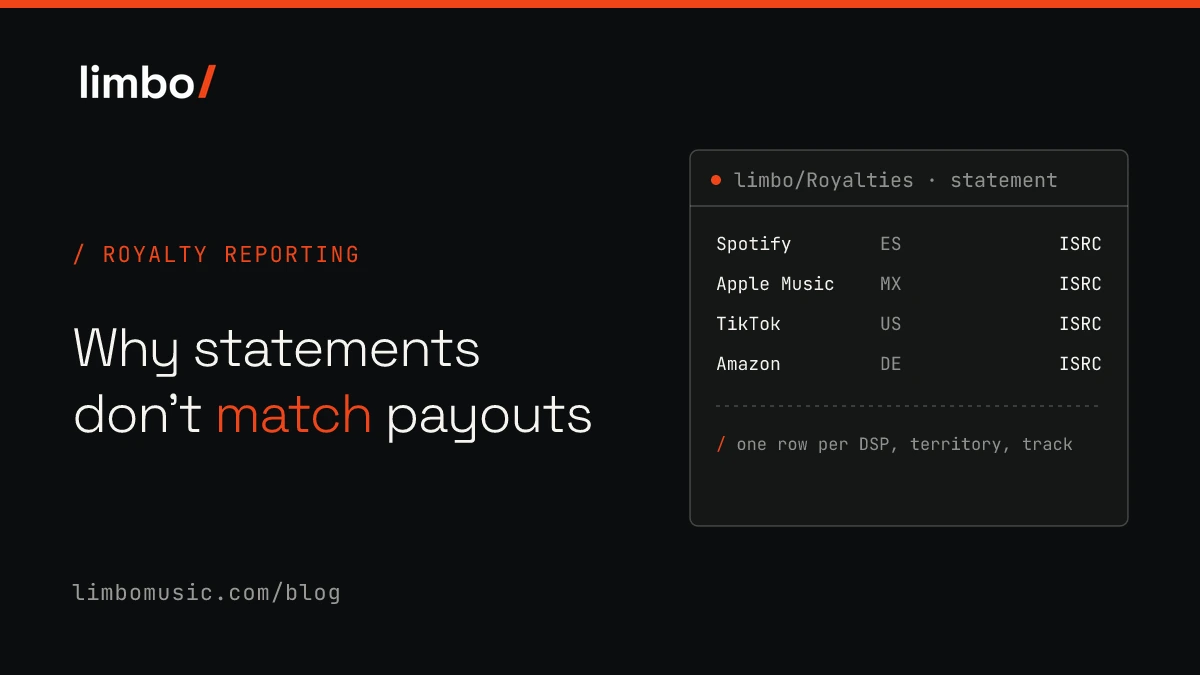
Reconciliation needs, at minimum, a row for every DSP, territory and track in every period. Without that, a label cannot tell whether a territory is missing, whether a DSP applied the wrong rate, or whether a release never reached a store it should have. limbo/Royalties reports line by line, per DSP, territory and track, on Curve, the royalty platform co-owned by Merlin.
What an auditable statement shows
| Field | What it tells you |
|---|---|
| Track title and ISRC | Which recording earned it |
| DSP | Which platform paid |
| Territory | Which country or region |
| Period | The exact reporting window |
| Streams or downloads | The raw usage figure from the DSP |
| Rate applied | The per-unit rate for that DSP and territory |
| Gross earnings | Before any deduction |
| Fee or commission | What the distributor kept |
| Net payable | What reaches the label |
Without every one of these columns, a label cannot run an independent audit. A statement with only a net total per release is a summary of a calculation you cannot check.
Why where your royalty data lives is a risk of its own
Royalty data is not only financial. It shows which tracks perform, where, on which platforms and how fast. That has competitive value. If a label’s royalty data sits inside infrastructure owned by a major label group or a venture-backed competitor, the label has no guarantee its catalog performance is not visible to someone who would like to sign its artists or buy its catalog.
limbo/ is founder-owned with no outside capital, and royalty data is private by design and never shared with the majors. Reporting runs on Curve, the platform Merlin co-owns, rather than on infrastructure controlled by a competing commercial interest. For a label comparing distributors, who owns the platform holding its royalty data matters as much as the accuracy of the statements.
Pulling royalty data through an API to reconcile it yourself
For technical teams, the most reliable approach is to pull royalty data straight from the platform instead of waiting for a formatted statement. That lets a label or distributor run its own calculations, cross-check against DSP data and catch discrepancies early instead of weeks after a payment cycle closes.
The limbo/ API exposes royalty data through GET /v2/royalties, and the same data comes as monthly CSV or XML. The API is REST and JSON:API with OAuth 2.0, and the limbo/Chat MCP server lets operators ask about royalties and catalog in plain language from Claude, ChatGPT or any MCP client.
Labels that already hold their own Merlin membership or DSP contracts can use limbo/ as their back office, the setup the industry calls SOBO (supply-own-back-office): DDEX delivery, per-DSP and per-territory controls and royalty reporting, while limbo/ never becomes a party to their licensing.
What to do next
The mismatch between a distributor’s statement and what the DSPs paid is a structural problem, not an arithmetic one. It comes from re-aggregation layers, staggered reporting cycles, summary statements that hide the detail, and royalty data held where you cannot see it. Fixing it takes line-by-line reporting from the source, direct or Merlin-routed DSP contracts, and data held by a company that does not compete with you.
Start by asking your current distributor for a sample export in CSV or XML with a row per DSP, territory and track. If they cannot produce one, the reconciliation problem will not go away on its own. To see what source-level reporting looks like, read about limbo/Royalties or talk to limbo/.
Keep reading: what happens to your royalty data · what DDEX is · who owns your music distributor